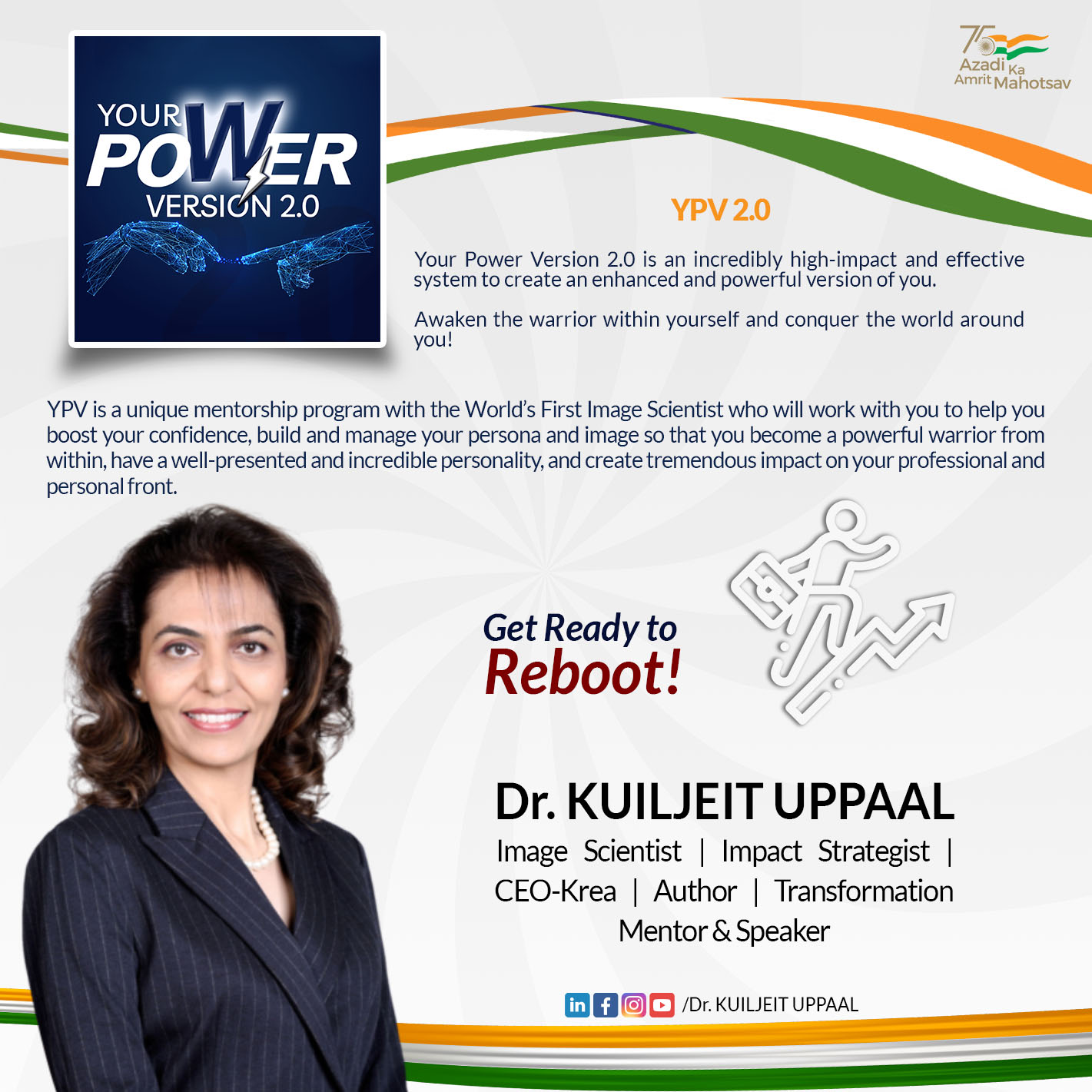
- Dr. Kuiljeit Uppaal
- Dr. Kuiljeit Uppaal
- Dr. Kuiljeit Uppaal
Who Is An Image Scientist?
Understanding the Science and Scholarship of Human Image Management
In today’s world, where authenticity and creating an impact
is of paramount importance, and where first impressions and personal branding
define success, the role of an Image Scientist has become increasingly
vital for holistic scientific transformation of individuals.
An Image Scientist is a super specialist from the Image
Management industry, who is academically a Research Scientist and Doctorate
holder in the subject, and has in-depth knowledge dealing with a person's Image
and Personality. An Image Scientist is an academic researcher, scholar,
and scientific expert who studies the complete human image through rigorous
research and interdisciplinary investigation. At the highest level of expertise
within the Image Management profession, an Image Scientist seeks to understand
not only how people are perceived, but why they are perceived
that way, and how those perceptions can be transformed through
structured, evidence-based interventions.
Unlike conventional image enhancement, which largely focuses
on visible presentation, the Image Scientist employs science and research to study,
analyse and enhance the individual ‘in totality’ —integrating the inner
self, outer self, and social self into one cohesive framework, to create authentic,
sustainable, and holistic transformation rather than superficial change.
Becoming an Image Scientist
Becoming an Image Scientist is the culmination of
years—often decades—of scholarly pursuit, scientific research, practical
application, and multidisciplinary learning. It demands far more than expertise
in grooming or communication.
An Image Scientist is expected to possess doctoral-level
academic competence, undertake original research, contribute new knowledge to
the discipline, and develop academic frameworks that can be scientifically
studied, tested, applied, and taught.
The role draws upon an extraordinary range of disciplines
including Psychology, Sociology, Anthropology, Semiotics, Neuroscience, Psychometrics,
Communication Studies, Behavioural Sciences, Management, Design and Aesthetics,
Fashion, Creative Expressive Therapy, Leadership Studies, Human Development,
Research Methodologies and Statistics, to mention a few.
The challenge lies not merely in understanding each of these
fields independently, but in synthesising them into an integrated scientific
understanding of human image. This requires analytical rigour, research
capability, systems thinking, and the ability to translate complex academic
concepts into measurable human development outcomes.
An Image Scientist therefore functions simultaneously as a
researcher, educator, strategist, diagnostician, behavioural analyst, mentor,
curriculum developer, and thought leader.
The Highest Level within the Image Management Profession
The Image Management profession comprises varying levels of
education, expertise, and professional practice. While professionals may
specialise as image consultants, corporate trainers, appearance consultants,
etiquette coaches, personal stylists, or communication experts, the Image
Scientist represents the highest academic and professional level within this
hierarchy.
This distinction is comparable to the difference between a practitioner who applies existing knowledge and a research scientist who expands the boundaries of knowledge itself. An Image Scientist contributes to the evolution of the discipline by generating new theories, conducting original research, creating frameworks, publishing scholarly work, and influencing educational practice.
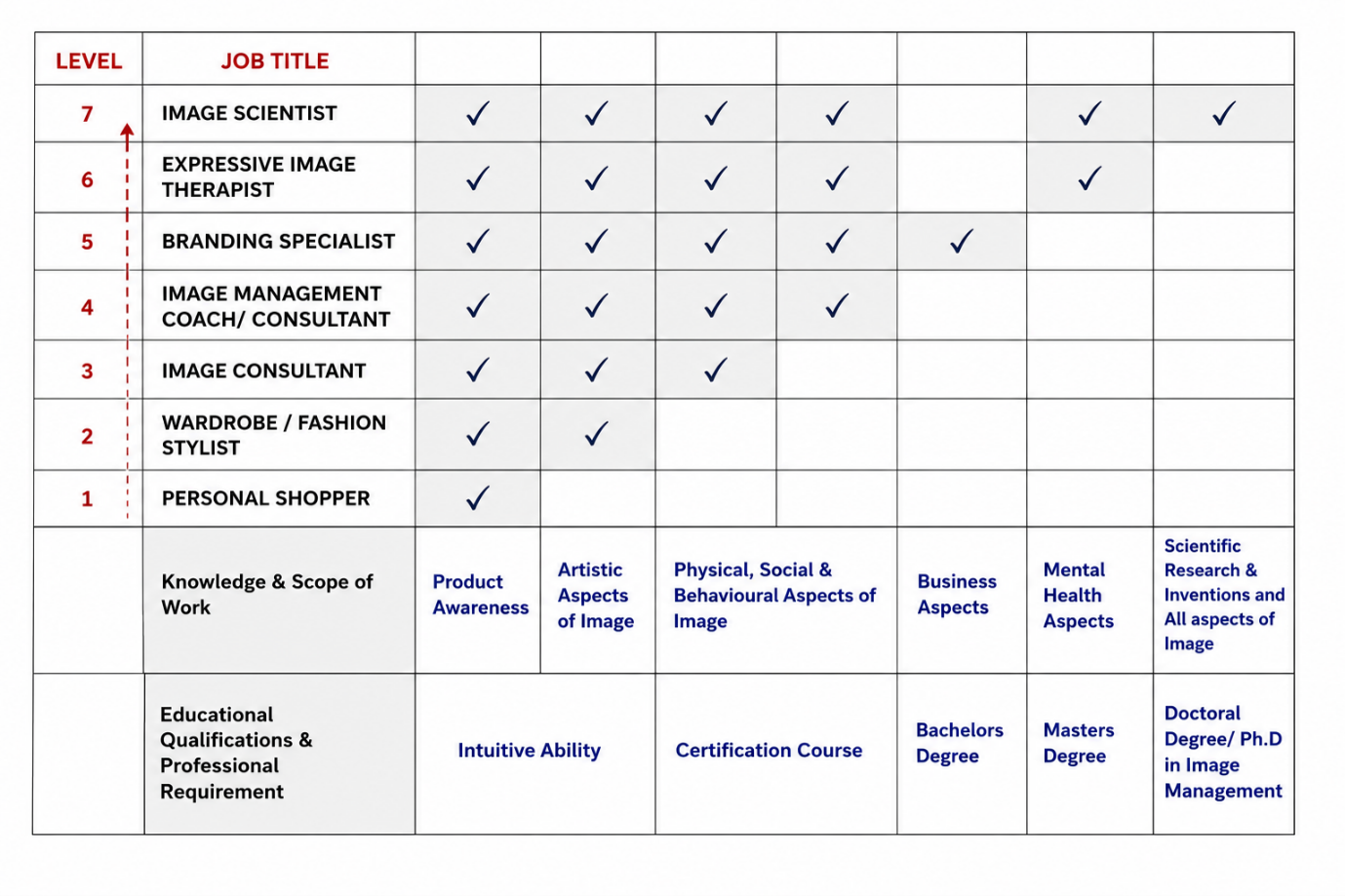
Interestingly, this perspective aligns with internationally respected Image Management thought leaders, who have similarly recognised the role of the Research Scientist as the highest level of academic scholarship within the profession.
Image Scientist: A Title Shared Across Industries
The designation "Image Scientist" is not exclusive
to the study of human image.
Professionals working in medical imaging, artificial
intelligence, satellite imaging, aerospace, remote sensing, computer vision,
and image processing are also referred to as Image Scientists because they
specialise in scientific analysis and interpretation of images within their
respective domains.
It is therefore important to distinguish the context in
which the title is being used. In the field of human Image Management,
an Image Scientist studies the science of the human persona and image—how
individuals think, behave, communicate, present themselves, build
relationships, influence others, and create lasting impressions.
Dr. Kuiljeit Uppaal and the Science of PRIM
Dr. Kuiljeit Uppaal is recognised as the World's First
Image Scientist and the world's first PhD holder in this specialised
domain. Her pioneering academic journey has resulted in years of original
interdisciplinary research, multiple world, continental, and national
recognitions, and the establishment of an entirely new scientific discipline
known as the Science of PRIM (Persona and Image Management).
The Science of PRIM is the world's first integrated
scientific architecture dedicated exclusively to the systematic study,
development, management, and optimisation of the complete human persona and
image. Rather than viewing personality, the human mind, values, communication,
grooming, behaviour, leadership, life skills, emotional intelligence,
professional presence etc as isolated competencies, PRIM organises them into a
unified evidence-based framework that explains how these dimensions interact to
shape human identity, perception, influence, performance, and long-term
success.
The architecture of the Science of PRIM brings together
knowledge from multiple disciplines into one coherent scientific system,
enabling educators, researchers, institutions, organisations, and individuals
to understand human development through a holistic lens. Beyond introducing a
new academic discipline, Dr. Uppaal's work has contributed to expanding Image
Management from a predominantly practice-oriented profession into a structured
field of scientific inquiry with applications across education, leadership,
employability, organisational development, and personal transformation.
As the discipline continues to evolve, the Image Scientist
stands at the forefront of this emerging body of knowledge—bridging research
and practice to unlock the full potential of the human persona with scientific
precision and purpose.
Frequently Asked Questions (FAQs)
1. What is an Image Scientist?
An Image Scientist is a doctoral-level researcher and super specialist
in the field of Image Management who studies, analyses, and develops the
complete human image using scientific research and multidisciplinary knowledge.
Unlike professionals who focus only on appearance or communication, an Image
Scientist examines and analyses the inner self, outer self, and social self to
facilitate authentic and holistic transformation.
2. Is an Image Scientist the same as an Image Consultant?
Not at all.
An Image Consultant primarily works with clients to improve
their appearance, behaviour, communication, etiquette, and overall professional
presence. An Image Scientist, on the other hand, operates at the highest
academic level of the profession. In addition to practical application, an
Image Scientist conducts original research, develops scientific frameworks, inventions
and contributes to academic literature, and advances the discipline itself.
3. What qualifications are required to become an Image
Scientist?
An Image Scientist is expected to possess advanced academic
qualifications, including a PhD in the subject, scientific research, along with extensive knowledge
across multiple disciplines such as psychology, sociology, neuroscience,
communication, behavioural sciences, management, design, aesthetics,
leadership, education, and human development.
Beyond formal qualifications, becoming an Image Scientist
requires years of original research, scholarly contribution, and the creation
or advancement of knowledge within the field.
4. What does an Image Scientist actually do?
An Image Scientist researches, studies, and develops human
image from a scientific perspective. Their work includes analysing personality,
behaviour, communication, perception, leadership presence, emotional
intelligence, professional identity, and social influence to design
evidence-based strategies for personal, academic, and organisational
transformation. The Image Scientist creates inventions, and empirically tested
systems and scientific concepts for academic creation and societal
transformational.
5. What is the Science of PRIM?
The Science of PRIM (Persona and Image Management) is the
world's first integrated scientific discipline dedicated to understanding,
developing, and managing the complete human persona and image through an
evidence-based, multidisciplinary framework.
It scientifically integrates knowledge from psychology,
sociology, communication, image, neuroscience, management, design, behavioural
sciences, leadership and several other disciplines into one cohesive scientific
architecture for holistic human development.
6. Who created the Science of PRIM?
The Science of PRIM was created by Dr. Kuiljeit Uppaal,
recognised as the World's First Image Scientist and the world's first PhD
holder in the specialised field of Image Management. Her pioneering research
has helped establish Persona & Image Management as a structured academic
discipline with applications in education, leadership, employability,
personality development, and organisational excellence.
7. Is the Science of PRIM recognised as an academic
discipline?
The Science of PRIM is increasingly finding its place within
academic and professional education worldwide. Through original research,
scholarly publications, educational frameworks, and the development of the
Science of PRIM, the discipline continues to evolve as a structured area of
scientific inquiry into human image, identity, and holistic development.
8. Why is Image Science important today?
In an increasingly interconnected world, technical
competence alone is no longer sufficient. Success also depends on credibility,
authenticity, leadership presence, communication, emotional intelligence,
adaptability, and the ability to build trust.
Image Science provides a scientific framework for
understanding and developing these interconnected dimensions, enabling
individuals to project their authentic potential with confidence and purpose.
9. Where can the Science of PRIM be applied?
The Science of PRIM has applications across multiple
sectors, including:
- Higher
Education
- Schools
and Universities
- Corporate
Leadership
- Human
Resource Development
- Entrepreneurship
- Public
Speaking
- Career
Development
- Employability
Skills
- Executive
Coaching
- Personal
Branding
- Leadership
Development
- Organisational
Behaviour
- Government
and Public Service
- Social
Development
10. Who is the World's First Image Scientist?
Dr. Kuiljeit Uppaal is recognised as the World's First Image
Scientist and the world's first PhD holder in the specialised field of Image
Management. She is the creator of the Science of PRIM (Persona and Image
Management), an integrated scientific discipline for understanding and
developing the complete human persona and image.
11. What is the difference between Personality
Development, Image Management, Personal Branding, and the Science of PRIM?
While these terms are often used interchangeably, they
represent different concepts.
- Personality
Development focuses on enhancing an individual's traits, behaviours,
and interpersonal effectiveness.
- Image
Management focuses on how an individual is perceived through
appearance, behaviour, communication, and overall presence.
- Personal
Branding is the strategic positioning and promotion of one's
professional identity and value proposition.
- The
Science of PRIM is a comprehensive scientific framework that
integrates personality, image, communication, behaviour, self-concept,
leadership, emotional intelligence, and strategic self-management into one
unified architecture for holistic human development.